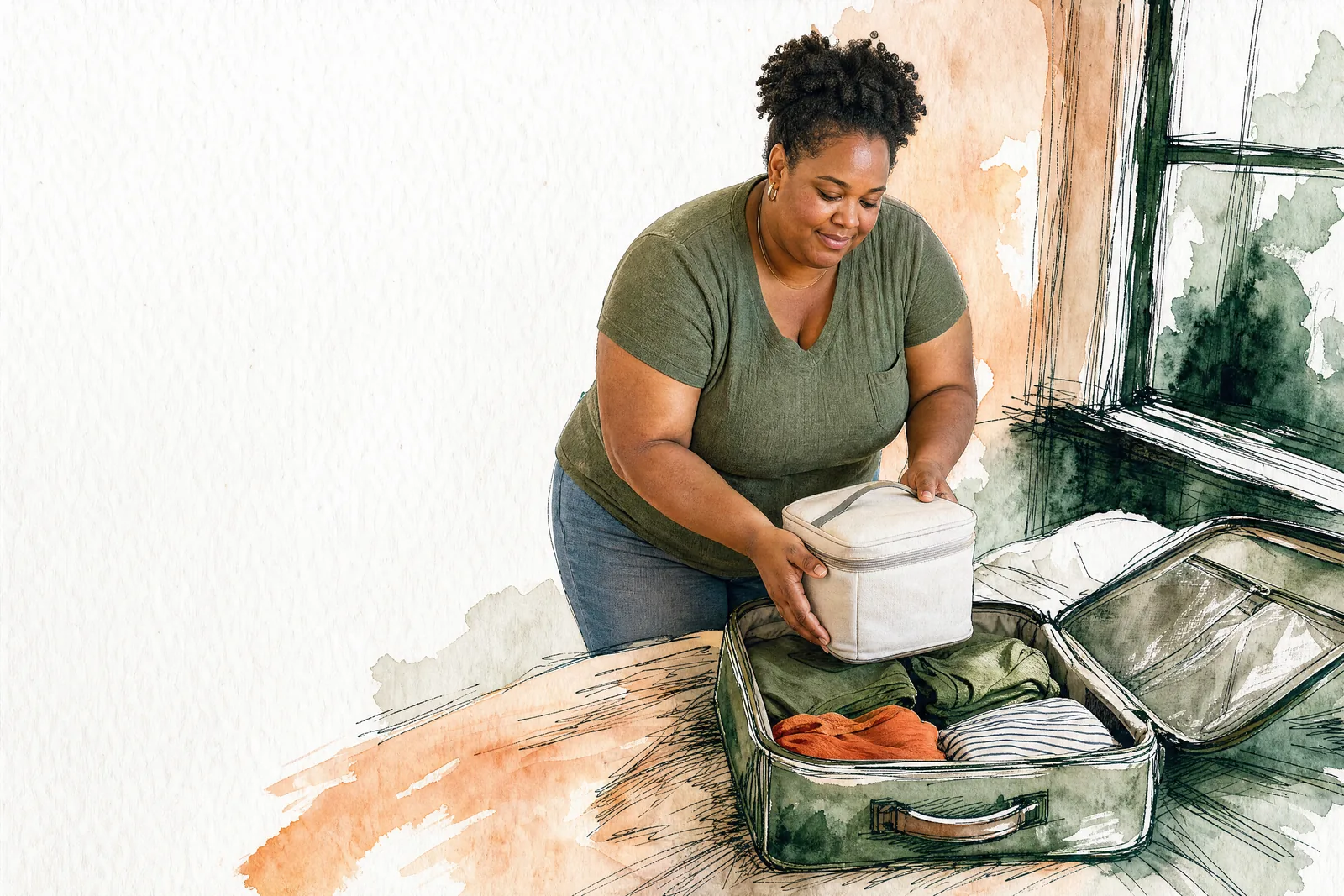
Pack the medicine, its ice packs and the needles in your carry-on bag. Medication may travel in carry-on or checked bags, and the carry-on is the strongly recommended place in case you need it quickly. Unused syringes are allowed when they travel with the injectable medicine they are for.
Carry-on or the checked bag
Carry-on, for two reasons. The first is access: if the flight is delayed or you need a dose on the way, it is with you. The second is loss: a checked bag can be lost or delayed with your whole supply inside, which is why travelers going abroad are advised to pack medicine in a carry-on in case luggage is lost or delayed, with enough for the whole trip plus extra in case of delays.
A checked bag also leaves the medicine somewhere you cannot see or control for hours, and extreme temperatures can reduce the effectiveness of many medicines. Before the day you fly, ask the pharmacy that filled yours, or your care team, how cold it has to stay and whether it may be out of the fridge at all.
What to tell the officer, and what happens next
Two things in your bag need saying out loud: the liquid medicine and the syringes. Tablets and other solid medicines do not have to be presented to the officer, but they are still screened. Liquids in carry-on bags are normally limited to 3.4 ounces, but liquid medication over that amount is allowed in reasonable quantities for the flight, does not need to go in a zip-top bag, and must be mentioned to the officer at the start of screening. Unused syringes are declared to the officer for inspection.
Keep the medicine, its ice packs and the syringes together in one pouch near the top of the bag, so they come out in one movement. At the checkpoint, the steps for medically necessary items are:
- Before the screening begins, tell the officer you have medically necessary liquids or medications.
- Take them out of your carry-on bag and put them in a bin or bowl.
- Expect a visual or X-ray screening, and possibly a test for traces of explosives.
If screening is hard for you, you or whoever is traveling with you can talk to the officer about the best way to get through it. You can also ask for the medicine not to go through the X-ray. Officers normally screen medication by X-ray, but you may ask for a visual inspection instead, as long as you ask before anything goes into the X-ray tunnel. For liquid medication, declining the X-ray means extra steps to clear the liquid and extra screening for you, which may include a pat-down.
If a medically necessary liquid, gel or aerosol sets off an alarm, it gets extra screening, and if the alarm cannot be cleared, the item may not be allowed through. You may be asked to open the container so the vapor can be tested, but nothing is ever placed into the liquid itself. Leave extra time at the checkpoint for all of this, and if anything goes wrong, you can ask to speak to a supervisor.
What goes where, item by item
| Item | Where it can go | At the checkpoint |
|---|---|---|
| Liquid medicine | carry-on or checked; carry-on strongly recommended | tell the officer at the start; over 3.4 ounces is allowed in reasonable quantities |
| Ice packs, freezer packs, gel packs | allowed frozen, partially frozen or melted, to keep medically necessary items cool | present them with the medicine; supplies for medically necessary liquids are screened too |
| Unused syringes | carry-on or checked | allowed with the injectable medicine; declare them for inspection |
| Labels and bottles | prescription bottles are not required | labeling is recommended, not required; some state laws on labeling apply |
The syringe allowance covers unused syringes. If your needles are a different kind, such as needles that screw onto a pen, call TSA on (866) 289-9673 before you fly and ask how to prepare them for screening.
Melted packs may still be presented at the checkpoint, and they are screened like everything else. Whether the medicine itself stayed cold enough is for the pharmacy that filled it to say.
A letter, and the pharmacy bottle
For a flight within the United States, you need neither. Medicine does not have to travel in prescription bottles, though some states have labeling laws you must follow. You can tell the officer about a medical condition out loud, show a TSA Notification Card, or hand over medical documentation; a letter is one way to do that, and nothing requires one.
Abroad, the destination's rules come first. Each country has its own laws on medicines, so check with the embassy of the country you are going to, and of any country you change planes in, that your medicines are allowed there. Keep medicines in their original, labeled containers, bring copies of every written prescription, and ask the provider who prescribes for you for a note if you use controlled substances or injectable medicines. That note is worth asking for this week.
Plan to use only the medicine you bring. Counterfeit drugs are common in some countries, so pack enough for the whole trip, plus extra for delays, and avoid buying replacements abroad unless you have to. A visit to your own provider or a travel health specialist at least 4 to 6 weeks before you leave is the place to raise anything about your medicine and where you are going.
Three more steps before a trip abroad. Leave a copy of your prescriptions at home with a friend or relative, in case you lose yours or need an emergency refill. If you are crossing time zones, ask your provider whether that changes when you take your medicine. And for a trip longer than 30 days, ask your provider how to get enough medicine, because some insurance companies will pay for only a 30-day supply at a time.
Check your cover for care abroad, too. Travelers usually pay hospital and other medical bills out of pocket at most destinations, so find out whether your health insurance covers care abroad, and think about travel insurance that does. Make a plan for getting care overseas before you need it, and consider extra insurance that covers health care and emergency evacuation, especially if you are going somewhere remote.
For help at the checkpoint itself, you can request a Passenger Support Specialist, an officer trained to assist travelers with medical conditions. Request one at least 72 hours before departure through TSA Cares, online or by calling (855) 787-2227. A specialist helps you through screening; you are still screened.
If your weight care comes through NicoCares, message your care team in Spruce well before you leave and ask how your medicine should be kept on the trip, since those messages have no promised reply time.
If a reaction cannot wait
A reaction after an injection can happen while you are away. A severe allergic reaction with trouble breathing, swelling or hives is a reason to call 911, or the emergency number wherever you are, or to go to an emergency department. Abroad, the nearest US embassy or consulate can help you find medical care and is available for emergencies 24 hours a day, 7 days a week. Some reaction signs mean calling the local emergency number at once (see Hives with trouble breathing after an injection mean 911).