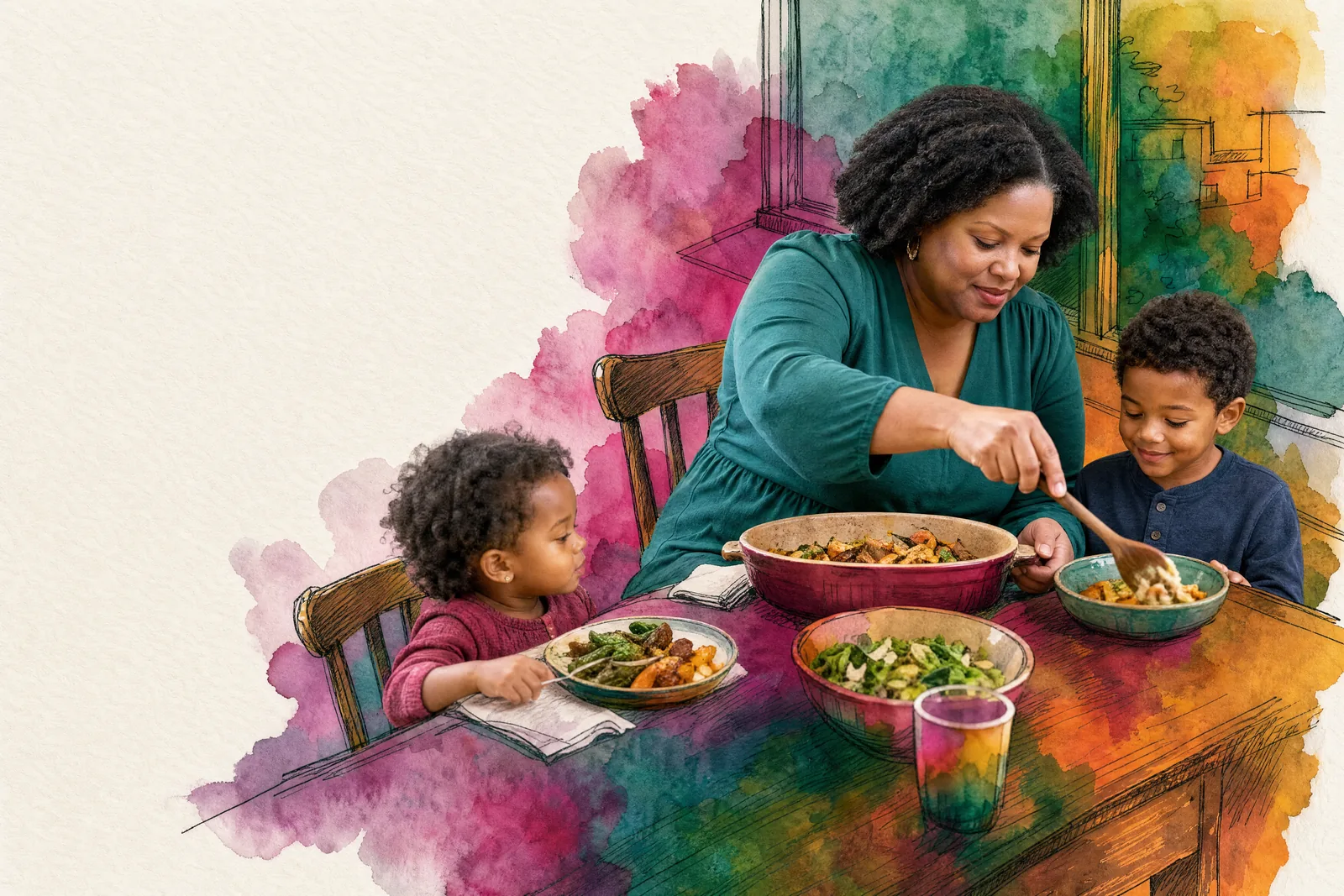
You still cook dinner for four, and you now eat about a quarter of what you used to. Your child, at nine, has begun eating about as little as you do at the same table, though nobody asked for that. Your plate reflects your own appetite and your own plan, while the child's has to fit a body that is still growing, and the two do not need to match.
How a nine-year-old picks up an adult's portion
Your nine-year-old may have picked the portion up from watching you: children are good learners, and they often copy what they see. The plate you serve yourself sits in plain view at the same table at every dinner, so it can teach a portion without anyone ever stating a rule. Your child sees how much is on it and none of the reasons it is small.
The same copying works for the food you want your child to take up, so model healthy eating at home by eating it yourself, on a plate of any size. The foods that help children and teens develop healthy eating habits are ones everyone at a family dinner can share:
- plenty of vegetables, fruits and whole-grain products
- meats, poultry, fish, lentils and beans for protein
- milk or dairy products, such as cheese and yogurt
- water in place of sugary drinks, for the whole family
What a child of nine needs now, and whether any of it comes as a number
A child of nine is nearing the years when needs go back up, and a few of those needs do come as numbers. A child grows at a steady pace from ages 2 to 10, and a final growth spurt begins at the start of puberty, sometime between ages 9 and 15. A child's nutrient needs follow those changes in growth, and they increase again as a child gets close to adolescence. Nine is the low end of that range, so your child could be close to the spurt or years away from it.
Day to day, children need meals and snacks that are high in nutrients to help them grow. A child with a poor diet may be tired and unable to learn at school, and breakfast is very important, since children may feel tired and unmotivated without a good one.
A healthy child will follow an individual growth curve, and the needed nutrient intake may be different for each child. These figures describe children in general and set no serving size for yours:
- Children older than 8 should have about 3 cups (720 milliliters) of milk a day, compared with about 2 cups for ages 2 to 8, and it may help to serve milk with meals and water between meals and with snacks.
- A snack should be the right size for the child: for example, half a banana for a 2-year-old and a whole banana for a 10-year-old. Going by those two ages, a nine-year-old is nearer the whole banana.
- In children age 4 years and older, fat calories should make up 25% to 35% of total calories, and some fat in the diet is needed for normal growth and development.
None of those figures shrinks because an adult at the same table eats less, and the fat range sets a minimum as well as a maximum. For ideas for healthy foods for your family, you can talk to a nutritionist or your family's health care provider.
Serving one dinner in two sizes without singling anyone out
Cook one dinner and plate it at two sizes, with the same kinds of food on every plate. A child's portion is set by the child's age, not by the adult in the next seat, so your smaller plate is no guide to it. If you are not sure how big a helping suits a nine-year-old, ask a health care professional, such as the child's doctor or a registered dietitian, who can identify habits that support a child's healthy growth and development.
Getting the whole family involved in building healthy eating, drinking, physical activity, and sleep habits means everyone benefits, and your child won't feel singled out. One dinner with the same food on every plate keeps the whole family in it, whatever the size of each helping.
Serve the child's helping without pressing the child to finish it, and keep food out of rewards and punishments: both help a child develop a healthy attitude toward food and eating.
Your own weight plan stays yours, and a child goes on a weight-loss plan only with the help of a health care professional (see Your teenager asked about a weight medicine. It is a question for her doctor).
If your child asks why the plates differ, answer in terms of growing. Talk with your child about health, including how regular physical activity, healthy eating, and getting enough sleep help our bodies get strong and stay healthy, and a bigger helping for a body that is still growing fits inside that conversation.
When a child eating less is a reason to call the child's doctor or 911
Talk to your child's provider if you have concerns about your child's growth and development. Faltering weight is the term for children whose current weight or rate of weight gain is much lower than that of other children of similar age and sex, and its symptoms include:
- height, weight and head circumference that do not match standard growth charts
- a weight under the third percentile of standard growth charts, or 20% below the ideal weight for the child's height
- growth that may have slowed or stopped
Those are measured on standard growth charts at the child's checkups rather than at home, so at a checkup, ask where your child sits on the chart. Regular checkups, sometimes called well-child visits, can help detect faltering weight in children, and a question about growth that can wait can be raised with the child's provider at the next one. If your child does not seem to be developing normally, contact your child's provider. A food log of what your child eats helps a provider track the child's calorie intake and feeding patterns. Talk with the child's provider before giving any dietary supplement.
Go to an emergency department or call 911 if your child passes out or faints, or is suddenly hard to wake up, too sleepy or confused. Those are among the problems that need emergency care in a child, whatever the child has been eating.
When you cannot tell whether something needs care and your child shows no sign of an emergency, contact your child's provider. If the office is closed, call or message it anyway: according to MedlinePlus, your message or phone call will be forwarded to someone who can help.
How little you eat yourself, and whom to ask about it
Your own small plate is a question for whoever manages your weight plan, or for your own doctor if nobody does. If a medicine you take is why you eat so little, ask the provider who prescribed it about changing the dosage or the medicine, and keep taking it until you have talked it through. A diet history, a note of each food and drink you have over 24 hours or longer, gives that conversation something to work from (see No appetite at all? Start by writing down one day of eating).
NicoCares is for adults aged 18 or older; if you use it, a licensed physician decides whether treatment is appropriate for you, and your child's portions are a question for your child's provider. Your care team answers questions about your own appetite in the Spruce app, and adjusting your dose stays part of your physician's role.