If you use a wheelchair, the weekly activity figures are the ones every other adult is given, as long as you are able to meet them: 150 minutes or more a week of aerobic activity at moderate intensity, for example 30 minutes on 5 days, plus muscle-strengthening that includes all major muscle groups on at least 2 days. They come from the Physical Activity Guidelines for Americans, the federal health department's advice behind the 150 minutes that activity pages quote. You can use them to see which of your own activities count, what to aim for when 150 minutes is more than you are able to do, and whom to ask about the right amount for your abilities.
Which bodies the 150 minutes was written for
The 150 minutes was written for a body like yours too, provided you are able to do it. The benefits of physical activity for people with disabilities have been studied in groups that include people with spinal cord injury, multiple sclerosis, cerebral palsy, muscular dystrophy, limb amputations and previous stroke, among others, and for many chronic conditions activity is part of the recommended treatment.
If you are able, the range runs from those 150 minutes up to 300 minutes of moderate activity a week, preferably spread through the week, and the strength work is of moderate or greater intensity.
For adults with chronic health conditions or disabilities, regular activity supports daily living activities and independence, improves sleep quality, helps control weight, and helps improve mental health by reducing depression and anxiety, among other benefits. In arthritis, it can decrease pain and improve function. Adults with disabilities are three times more likely than adults without disabilities to have heart disease, stroke, diabetes or cancer, and aerobic activity can help reduce the impact of these chronic diseases.
When the weekly totals are out of reach
When the weekly totals are beyond what you are able to do, stay regularly active according to your abilities, and avoid inactivity. Falling short of the figures because you are not able to meet them still leaves you within the same key guidelines as the 150 minutes.
There is no smaller fixed number to aim for in place of the 150 minutes. The type and amount of activity should be set by your abilities and by how severe the condition or disability is, which may change over time. If you do very little now, even a small step up is worth having: people doing the least physical activity benefit most from even modest increases in moderate-to-vigorous activity.
Some physical activity is better than none, and adults who do any amount of it gain some health benefits, though the aim is still to be active regularly. Bouts of aerobic activity of any length may be counted toward your total, and even short episodes or small amounts of physical activity are beneficial.
Doctors are told that patients with disabilities need to start slowly, based on their abilities and fitness level, for example by being active for a few minutes at a time and slowly building up over several weeks, if necessary (see Can you start moving when your knees already hurt?).
What counts when walking is not available to you
When walking is not available to you, wheeling yourself can count, and so can wheelchair basketball, tennis, football or softball, hand-crank bicycling, swimming laps and seated volleyball. The aerobic activities worth including are ones that make you breathe harder and your heart beat faster (see How hard does a walk have to be to count as moderate?).
Each part of the weekly aim has a walking or equipment example and a wheelchair or adapted one:
| Part of the weekly aim | Example on foot or with equipment | Wheelchair or adapted example |
|---|---|---|
| Moderate aerobic activity | Brisk walking | Wheeling yourself in a wheelchair |
| Vigorous aerobic activity | Jogging | Wheelchair basketball |
| Aerobic activity on the way somewhere | Walking or biking to places | Wheelchair rolling to places |
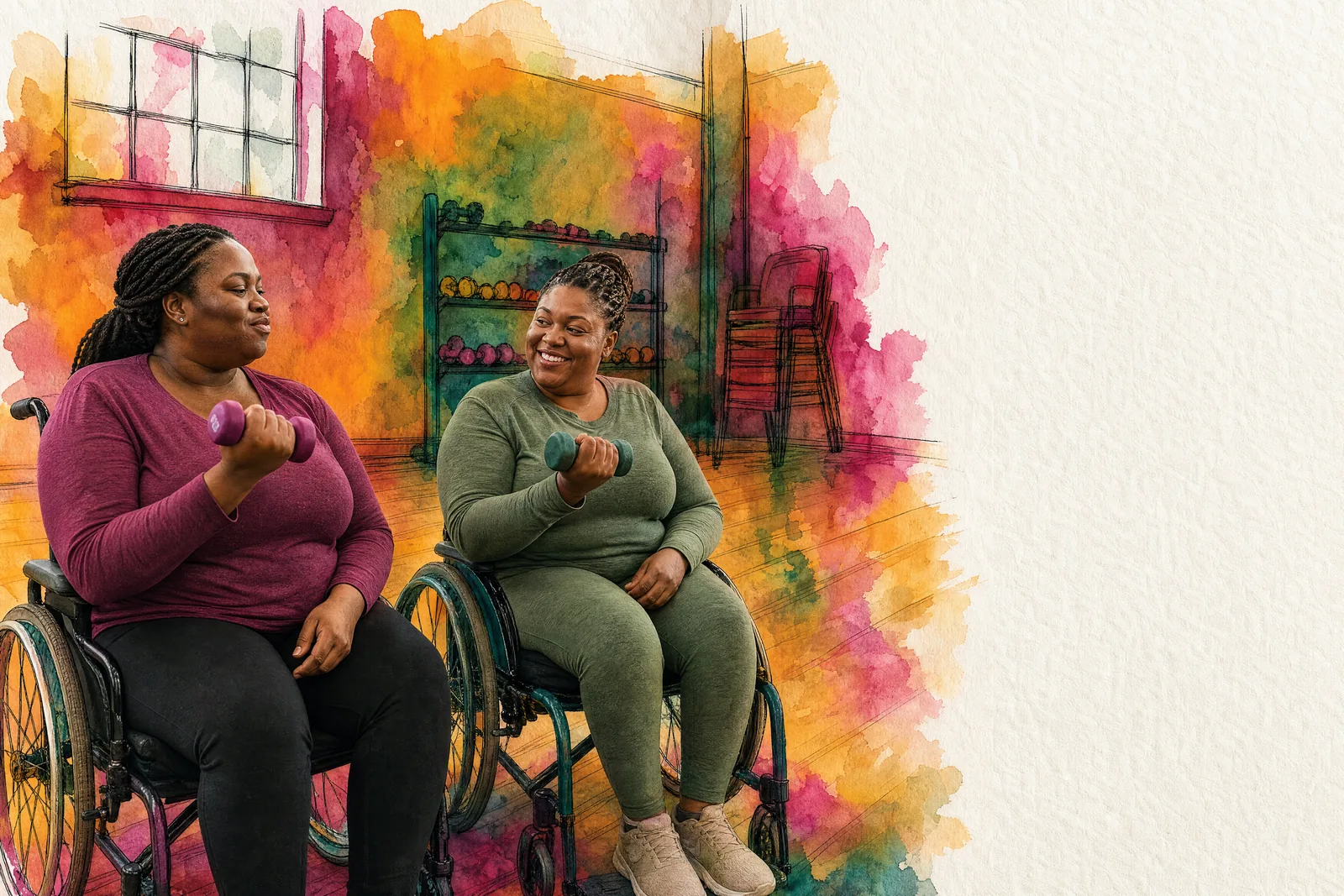
| Muscle-strengthening, 2 or more days | Exercise bands, weight machines or handheld weights | Resistance bands or adapted yoga |
Every entry is an example, so an activity missing from the table is not ruled out: aquatic therapy, rowing and water aerobics may count as well, among others. Most aerobic activity may need to be modified or adapted, or may need extra assistance or equipment.
With a vigorous activity such as wheelchair basketball, the aim is 75 minutes a week, and when you mix the two, 1 minute of vigorous activity is about the same as 2 minutes of moderate activity, as a rule of thumb.
On the muscle-strengthening days, the work is at moderate or high intensity and involves all major muscle groups, for example working with resistance bands or adapted yoga (see Strength work twice a week, and why it matters during weight loss).
The question to put to your doctor or a specialist
Put this question to your doctor or to a physical activity specialist: which amounts and types of physical activity are appropriate for my abilities? If you have a chronic condition, a health care professional or physical activity specialist can advise on the types and amounts that suit it as well, and with a chronic condition or symptoms you should be under the care of a health care practitioner.
Raise it yourself, because it may not come up. Among adults with disabilities who saw a doctor in the past year, only 44% received a physical activity recommendation from that doctor, and adults with disabilities whose doctor recommended activity were 82% more likely to be physically active. Nearly half of all adults with disabilities get no leisure-time aerobic activity.
Your doctor may ask how much activity you do each week, how often, for how long and at what intensity, which kinds you enjoy now or enjoyed in the past, and how you could add more.
If getting to an accessible program, or knowing that one exists, is what holds your activity back, tell your doctor that too. Adults with disabilities face barriers such as knowing about and getting to programs, places and spaces where they can be physically active, limited information about accessible facilities and programs, and finding fitness and health professionals who can offer options that match their abilities.
Certified Inclusive Fitness Trainers hold a certification from the American College of Sports Medicine (ACSM) and the National Center on Health, Physical Activity, and Disability (NCHPAD), and they have specialized training in exercise precautions for people with disabilities and in adapted methods of exercise training. To find certified health and fitness professionals nearby, try ACSM ProFinder, and ask your local YMCA whether its fitness center has adaptive equipment. NCHPAD works on physical activity, recreation and sport for people with disabilities; call it toll-free at 1-800-900-8086, voice and TTY. The Move Your Way guide, written for adults including those with a disability, has interactive instructions on getting started with physical activity. If you register for NCHPAD's 14 Weeks to Healthier You program, you can get physical activity options and nutrition advice for people with disabilities at no cost.
If you have a NicoCares care team, you can put the same question to them in Spruce, the app they answer patients in. Whether weight treatment is clinically appropriate for you is a physician's decision, and the physician who makes it is licensed in your state.