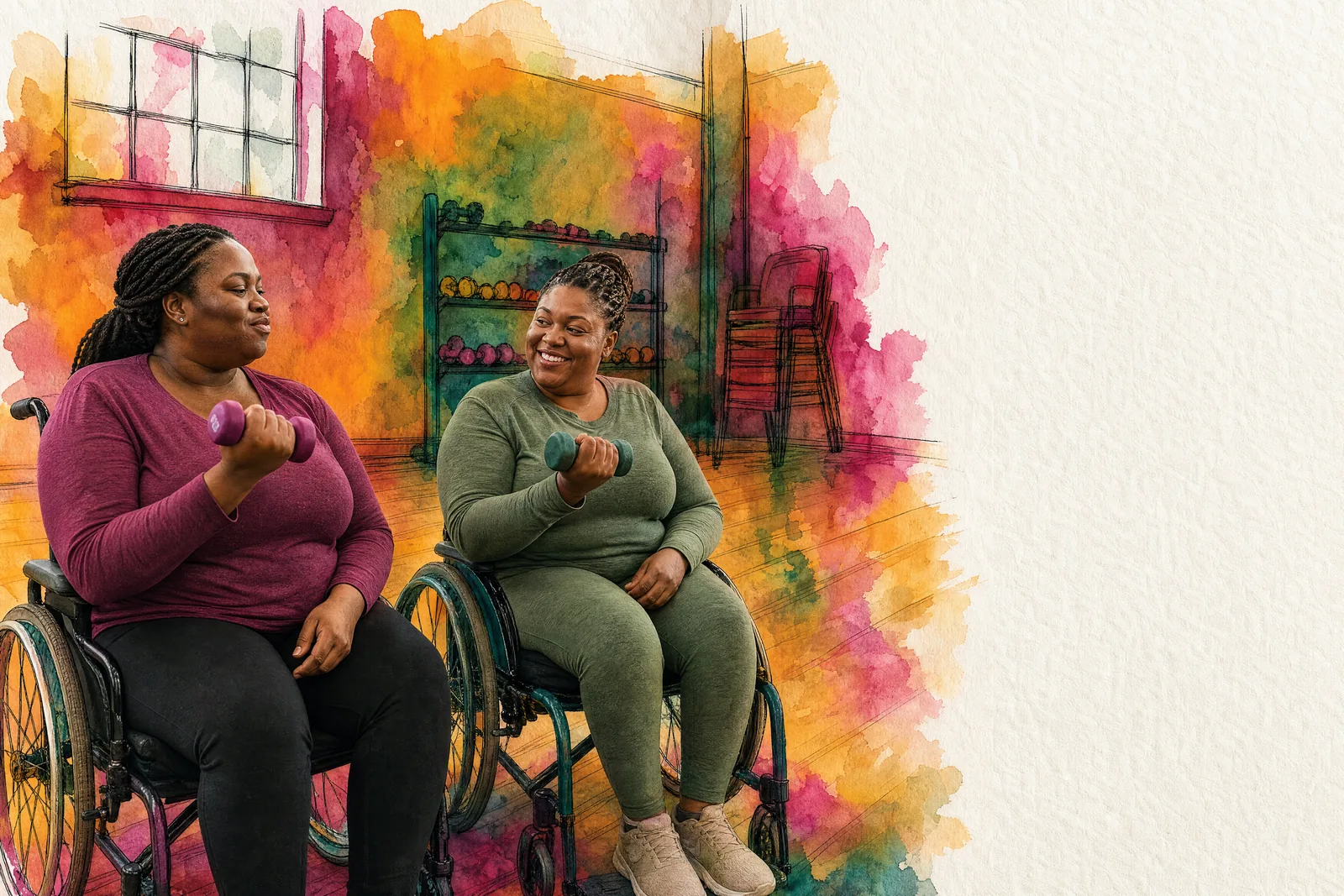
Count the chair stands and the arm curls you can safely do in 2 minutes, and time how long a fixed walk takes you, once a month: those are three of the five tests on a one-page monthly progress sheet from the National Institute on Aging, or NIA. A chair stand is rising from a chair to a full stand and sitting back down, and an arm curl is lifting a weight in your hand by bending your elbow. Set each new count against your own from the month before, and you can check what a scale cannot: whether the strength and endurance behind the stairs, the shopping and getting up from a seat have changed since you started strength work.
How far to trust how the stairs feel
How a flight of stairs feels is worth noticing, but it is not enough to go by on its own, because it can differ from how strong your legs actually are. You may feel weak with no real loss of strength, which is called subjective weakness and may come with an infection such as the flu, while a loss of strength that can be found on a physical exam is called objective weakness.
How a climb feels also depends on the day and the load you carry, and an impression leaves nothing behind to set against next month's, while a count leaves a number you can compare.
The chair stand also comes in a 30-second version that clinicians use, and counted over 30 seconds it reflects leg strength reasonably well and gives much the same number when repeated 2 to 5 days later, at least in generally active adults over 60 living in the community. It also came out lower in the less active people tested than in the more active ones. If you are under 60, bear in mind that all of this was measured in people older than you.
What to count at home for stairs, shopping bags and getting up
Each test stands in roughly for one everyday task:
| Everyday task | What to count | What stays the same each month |
|---|---|---|
| Climbing stairs, getting up from a chair | Chair stands, in 2 minutes or in 30 seconds | The chair, the length of time and the rules for what counts as a stand |
| Carrying shopping bags | Arm curls in 2 minutes | The weight you curl and the way you curl it |
| Walking to the shops, or a flight of stairs at home | Seconds to cover a fixed course | The course |
| Getting up off the floor | No count; a line in words | Nothing to hold the same; note what you held on to, if anything |
List the everyday things you want to keep doing as you grow older, such as taking laundry up and down the stairs, and the list tells you which of your counts to watch most closely.
Pick one length and keep it for every count after the first: the sheet's 2 minutes, or the 30 seconds of the CDC's clinical version, used to test leg strength and endurance on a chair with a straight back and no arm rests, timed with a stopwatch.
Learn the arm curl once from someone who can watch you do it, and do it the same way from then on. A personal trainer, one to one or in a small group, can teach you proper form, and things you already have at home, such as books or a detergent jug, can serve for muscle-strengthening work. Whatever you curl, curl the same one each month.
For the walk, pick a fixed course, such as the distance from your house to the corner, and see how long it takes you to walk it. A flight of stairs at home works as a course too, if that is the task you care about, and climbing stairs or hills is one of the moderate-intensity activities that build endurance, the aerobic kind that increases your breathing and heart rate, so your breathing is part of how a timed flight goes (see Is it normal to be out of breath after one flight of stairs?). Getting up off the floor has no test on the sheet; write a line about how it went beside the month's counts.
Making this month's count fair to compare with last month's
Take every month's count on the same chair, because seat height alone changes how many times older adults stand up in 30 seconds.
Keep the rules the same too. You sit in the middle of the chair, arms crossed at the wrists with each hand on the opposite shoulder and held against your chest, feet flat and back straight; a stand counts when you come all the way up, being more than halfway up when time runs out counts as one, and needing your arms to stand stops the test with a score of zero (see Caught yourself on the stairs twice? Tell your doctor). Have someone stand next to you for safety while you count, and use the same rules whichever length you chose.
If you are 60 or older, ask your own doctor about the 30-second count as a falls check. Clinicians score it against below-average scores by age and sex, in rows that start at 60 to 64, with the test taken on a straight-backed chair with no arm rests and a 17-inch seat, and a below-average score indicates a risk for falls. The counts you take at home are for comparing with your own earlier ones.
Take the count on a day your muscles are not sore from training. Overdoing muscle-strengthening exercises can cause exhaustion, sore joints, and muscle pain or injury, and a count taken on a sore day tells you about that day (see Soreness or injury two days after lifting weights? The signs to check).
Record each count in that month's column of the NIA sheet, with the date beside it. If a count ever falls, the date is what tells a doctor when the change began.
Don't compare yourself with younger people, because everyone is unique and we all age differently, and a partner who started training when you did is no better a yardstick (see Why the same dinners move one partner's weight and not yours).
If your count stays flat or starts going down
A flat count does not by itself mean the work is doing nothing, since muscle-strengthening exercise is key to keeping the strength you already have and slowing the loss of muscle mass; a count alone cannot tell you whether that is what a flat month shows (see Why the same routine does less once you reach your goal weight). People also differ: some have a hard time gaining muscle no matter how much they lift, and researchers are still working out why.
Take a flat count, with the dated sheet, to your own doctor or an exercise professional at your next visit. Doctors and exercise professionals can assess how active you are now, advise on ways to progress at a safe and steady pace, and keep supporting you through follow-up appointments. One thing to check with them is the schedule: muscle-strengthening work is advised on at least two days a week, covering the major muscle groups, without working the same group on two days in a row (see Strength work twice a week, and why it matters during weight loss).
A count that keeps going down over several months, with no soreness, illness or break from training to explain it, can be a sign of weakness that does not go away and has no cause you can explain, so book a visit with your own doctor for it. Expect to be asked when the weakness began, how long it has lasted and whether you have it all the time or only at certain times, and perhaps about the medicines you take and whether you have been ill recently; the dated counts answer the first two. Weakness like that needs a doctor's attention, because general weakness could be related to sarcopenia, the age-related loss of muscle mass and strength, which has been connected to trouble standing, walking and climbing stairs, or to another medical condition.
Sudden numbness or weakness of the face, an arm or a leg, especially on one side of the body, is a warning sign of a stroke, and so are sudden confusion or trouble speaking or understanding speech, sudden trouble seeing in one or both eyes, sudden difficulty walking, dizziness or loss of balance or coordination, and a sudden severe headache with no known cause. If you think you or someone else is having a stroke, call 911 right away.
If none of those stroke signs is present, phone your own doctor's office if you notice any of these kinds of weakness:
- sudden weakness, especially without other symptoms such as fever
- sudden weakness after being ill with a virus
- weakness that does not go away and has no cause you can explain
- weakness in one area of the body, whether or not it came on suddenly
NicoCares measures success in energy, comfort and mobility and promises no outcome. If NicoCares connected you with your physician, send your dated counts, flat months included, to your care team as a message in Spruce Health, where they answer you. For weakness, skip the message: NicoCares does not handle emergencies, so call 911 if it could be a stroke and your own doctor's office for the other kinds on the list above.